What Is Tinnitus? Ringing, Buzzing, and Hissing Explained
Tinnitus is the perception of sound — ringing, buzzing, hissing, clicking, or roaring — with no external source producing it (see the full range of tinnitus symptoms for how differently this can actually present from person to person). It isn't a disease in itself; it's a symptom, usually of something happening in the auditory system or in the way the brain is processing sound signals.
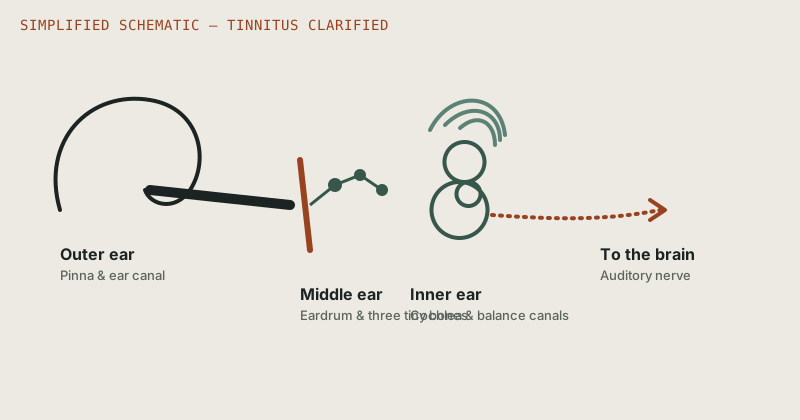
That distinction matters. It means tinnitus almost always has an underlying driver, and understanding that driver is what separates useful treatment from guesswork — see can tinnitus be cured? for an honest answer to the question almost everyone asks first.
How common is it, really
Estimates vary depending on how a study defines tinnitus and who it surveys, but there is a single best answer to start from. A 2022 systematic review and meta-analysis in JAMA Neurology pooled prevalence estimates from 83 studies published between 1972 and 2021 and put the prevalence of any tinnitus among adults at 14.4% (95% CI 12.6–16.5%). Individual studies ranged from 4.1% to 37.2%, which is the real reason national figures disagree as much as they do. Severe tinnitus came out at 2.3%, chronic tinnitus at 9.8%, and diagnosed tinnitus — tinnitus someone actually went to a clinician about — at 3.4%. Scaled to the world's adult population, the authors put it at more than 740 million adults, with more than 120 million experiencing it as a major problem.
Individual countries fill in around that pooled figure. An analysis of Dutch general practice records put prevalence in the Netherlands at around 15%, trending upward as more patients seek care for it.
A 2025 UK Biobank study using machine learning found an even higher figure in its cohort: just over a fifth of participants reported tinnitus, and roughly a quarter of those described it as moderately or severely distressing. The same analysis found tinnitus was more common in men and became more prevalent with age, while women in the study tended to report greater distress from it.
In the United States specifically, NIDCD estimates that around one in ten adults has experienced tinnitus lasting at least five minutes within the past year — close to 24 million people.
Why it happens without any actual sound
The leading explanation isn't that the ear is manufacturing sound. It's that when the auditory system loses part of its normal input — most often from damage to the tiny hair cells in the cochlea — the brain's hearing pathways can become hyperactive, effectively "filling in" the missing frequency band with a phantom signal. This is why tinnitus is so strongly linked to hearing loss, and why it often shares a pitch with the frequency range where hearing has been damaged.
Age is the clearest risk factor, and the meta-analysis puts numbers on it: 9.7% of adults aged 18 to 44, 13.7% of those 45 to 64, and 23.6% of those 65 and over. The UK Biobank cohort shows the same climb, peaking between roughly 65 and 79 before declining somewhat after 80.
Sex is less settled than it is usually stated. Large single cohorts — UK Biobank among them — report higher rates in men from 40 through 79, a gap generally attributed to greater historical exposure to occupational and recreational noise. The pooled meta-analysis found no significant difference: 14.1% among men against 13.1% among women. Both results can stand — a real gap in particular populations, and none once 83 studies across many countries are averaged — but "men get tinnitus more often" is a stronger claim than the best pooled evidence supports. What does recur across datasets is a difference in distress rather than prevalence: women who have tinnitus tend to report being more bothered by it. That pattern shifts again for some women specifically around menopause, a hormonal connection worth knowing about separately from the general age trend.
It's a symptom, not a single condition
"Tinnitus" is really an umbrella term. It shows up alongside noise-induced hearing loss, age-related hearing decline, earwax blockage, certain medications, temporomandibular joint (TMJ) problems, and — less commonly — vascular or neurological conditions, or structural inner-ear causes like otosclerosis, superior canal dehiscence, or autoimmune inner ear disease, that need a doctor's attention. That's also why two people with "tinnitus" can have very different experiences, causes, and treatment paths — this site's free risk factors checklist is a quick way to see which of the documented contributors might apply to you specifically, each linked to the article covering the actual evidence behind it.
When to see a professional
Occasional, brief ringing after a loud concert isn't usually a concern. But tinnitus that is persistent, one-sided, pulsing in time with your heartbeat, or accompanied by hearing loss, dizziness, or ear pain warrants an evaluation by an audiologist or ENT — some causes are straightforward to treat once identified. If hearing loss came on suddenly, alongside the tinnitus, that's its own medical emergency — see sudden hearing loss and tinnitus for why that specific combination needs care within days, not weeks.
The basic classification system doctors actually use
Not all tinnitus is the same, and the terms used to describe it aren't just casual description — they shape how a doctor approaches evaluation.
Subjective vs. objective. The vast majority of tinnitus is subjective — only the person experiencing it can hear it. A small minority is objective: a real, physical sound that a clinician can sometimes hear too, with a stethoscope or careful examination. Objective tinnitus almost always points to a specific physical source, such as blood flow (see the article on pulsatile tinnitus) or muscle spasms in the middle ear (see the article on middle ear myoclonus) — a meaningfully different diagnostic path than the subjective, neurologically-driven tinnitus most people have.
Pulsatile vs. non-pulsatile. This is one of the first questions an audiologist or doctor will ask, because it changes the whole evaluation. Pulsatile tinnitus rises and falls in rhythm with your heartbeat and is generally linked to blood flow near the ear — its own dedicated article on this site covers when that warrants imaging. Non-pulsatile tinnitus — a steady tone, hiss, or buzz that doesn't pulse with your pulse — is the far more common type, and is what most of the causes and treatments on this site are built around.
Acute vs. chronic. Tinnitus lasting under six months is often described as acute, and has a meaningfully higher chance of resolving on its own, especially if linked to a temporary cause like a loud event, earwax, or a cold. Tinnitus persisting beyond six months to a year is generally considered chronic, and the treatment focus typically shifts from "waiting for it to resolve" toward the management approaches — sound therapy, CBT, addressing an underlying cause — covered throughout this site.
Knowing where your own tinnitus falls on these three axes is genuinely useful before your first appointment — it helps you describe it precisely, and it's often the first thing a clinician will ask about anyway.
The rest of this section walks through the specific, evidence-backed causes in more detail, starting with the most common one: noise exposure.
Sources
- Jarach et al., 2022 — Global Prevalence and Incidence of Tinnitus: A Systematic Review and Meta-analysis, JAMA Neurology, PMC
- NIDCD — Tinnitus Fact Sheet (NIH)
- Bes et al., 2024 — The impact of tinnitus on Dutch general practices, PLOS ONE
- Hobeika et al., 2025 — Tinnitus risk factors and its evolution over time, Nature Communications
Frequently asked questions
Is tinnitus a disease?+
No. Tinnitus is a symptom, not a disease in itself — it's usually a sign of an underlying issue in the auditory system or in how the brain processes sound signals.
How common is tinnitus?+
The best pooled estimate is 14.4% of adults, from a 2022 JAMA Neurology meta-analysis of 83 prevalence studies — more than 740 million adults worldwide, with over 120 million experiencing it as a major problem. Individual studies range from 4.1% to 37.2% depending on how tinnitus is defined and who is surveyed, which is why national figures vary so much. Prevalence climbs with age: 9.7% of adults 18 to 44, 13.7% of those 45 to 64, and 23.6% of those 65 and over.
Why do I hear ringing when there's no sound?+
The leading explanation is that when hair cells in the cochlea are damaged, the brain's auditory pathways become more sensitive to compensate, and that overactivity is perceived as a phantom sound.
When should I see a doctor about tinnitus?+
See a doctor if tinnitus is persistent, one-sided, pulses in time with your heartbeat, or comes with hearing loss, dizziness, or ear pain.
Related reading
causes
Tinnitus Symptoms: What People Actually Experience
Ringing is just the most common word for it — tinnitus shows up as many sounds and patterns. What's typical, and what warrants prompt attention.
5 min read
causes
Vertigo, Dizziness and Tinnitus: Why They Travel Together
Tinnitus and vertigo share the same inner-ear real estate, and people with tinnitus face a meaningfully higher rate of positional vertigo than those without.
4 min read
causes
Objective vs. Subjective Tinnitus: What the Difference Means
Nearly all tinnitus is subjective, heard only by you. The rare objective kind can be heard by an examiner, and that difference changes the diagnostic path.
4 min read
research
Global Tinnitus Prevalence, By the Numbers
How many people actually have tinnitus, worldwide and by country — and why the estimates vary as much as they do.
4 min read
What Is Tinnitus? Ringing, Buzzing, and Hissing Explained — https://www.tinnitusclarified.com/articles/what-is-tinnitus
Published 2026-07-15, updated 2026-09-05. Every claim on this page cites a named source; the full list is above.
How this page is maintained
Every factual claim above is tied to one of the 4 named sources listed on this page, last checked . How we decide what to publish explains what counts as a source here and what does not.
When we get something wrong we say so on the corrections page rather than editing it away quietly. If something on this page looks wrong to you — a number, a citation, a claim that has been superseded — tell us, and say which sentence.
Tools & resources
Free tool
Tinnitus impact self-check
See how much tinnitus is actually affecting daily life, mood, and coping — 2 minutes, free.
Free tool
Online hearing test
A free tone-based check across standard audiometric frequencies, ear by ear.
Research library
Every source cited on this site
The primary studies behind this article and every other, aggregated in one place.