TMJ Disorder and Tinnitus: The Jaw-Ear Connection
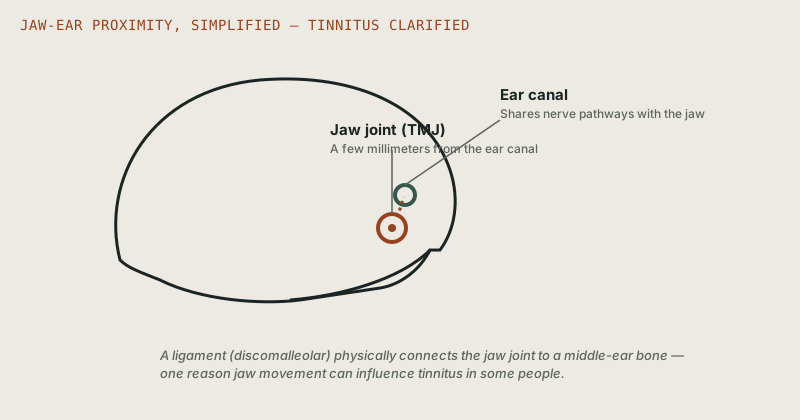
The temporomandibular joint (TMJ) — where the jawbone meets the skull, just in front of the ear — turns out to be close enough to the ear's own structures that problems in one can plausibly affect the other. This connection is well-documented in the research, even though the exact mechanism is still being worked out.
The anatomical link
A specific ligament (the discomalleolar or Pinto's ligament) connects the TMJ disc to the malleus, one of the three tiny bones in the middle ear — meaning a physical, structural link exists between the jaw joint and the hearing mechanism, not just a coincidental proximity. Nerve pathways add a second route: the trigeminal nerve, which handles jaw sensation, connects into the same brainstem circuits involved in processing sound, giving jaw-related signals a plausible way to influence what the auditory system perceives.
How doctors tell if TMJ is actually involved
The clearest clinical sign isn't just having both TMJ pain and tinnitus at the same time — it's whether the tinnitus changes when you move your jaw. This is called somatic (or somatosensory) tinnitus: if clenching, opening your mouth wide, or moving your jaw side to side changes the pitch, loudness, or presence of your tinnitus, that's considered a meaningful sign that your temporomandibular or neck muscles are contributing to it. One study modulating tinnitus with jaw and neck movements found this kind of testing could reliably help identify patients who also had a diagnosable TMJ disorder. If jaw movement does nothing to the sound, a TMJ connection is much less likely.
How common the overlap actually is
Research estimates vary, partly because TMJ disorders themselves are diagnosed differently across studies, but tinnitus is reported in a substantial share of people with TMJ disorders — some studies put co-occurrence as high as the 19–69% range, skewing toward women by roughly two to one, consistent with TMJ disorders generally being more common in women. A pooled analysis across 16 studies found an average TMJ disorder rate of 44% specifically among tinnitus patients — meaning nearly half of people with tinnitus in the reviewed studies also had a diagnosable TMJ disorder, whether or not they'd connected the two themselves. One frequently cited study found the picture from the other direction just as striking: tinnitus incidence was more than eight times higher in people with TMJ disorders than without (36.6% versus 4.4%), and among patients specifically reporting pain on TMJ palpation, having that pain was linked to a more than doubled risk of developing tinnitus over the following five years.
What treatment outcomes actually look like
This is genuinely useful to know precisely, because the numbers are better than "might help a little": that same pooled analysis found 69% of patients reported improvement or resolution of their tinnitus after TMJ disorder treatment, against 32% who saw no change. A separate controlled study found 43% of patients in a TMJ treatment group had decreased tinnitus two years later, compared with only 12% in an untreated control group — a meaningful, several-fold difference that supports a real treatment effect rather than tinnitus simply improving on its own over time. Individual studies using bite splints specifically have reported tinnitus fully resolving in roughly a quarter of treated patients, alongside partial improvement in others.
It's worth being precise about the evidence quality here too, in the same spirit as the rest of this site: systematic reviews of TMJ physical therapy for tinnitus consistently note the underlying studies carry a real risk of bias — mostly due to small sample sizes and a lack of blinding, which is difficult to achieve for a physical treatment like jaw exercises or splints. The direction of the evidence is consistently positive across every review found, but the certainty is lower than for a treatment like CBT, where much larger, better-controlled trials exist.
Treatment: address the jaw, see if the sound follows
When TMJ-related tinnitus is suspected, treatment targets the temporomandibular disorder itself rather than the ear directly:
- Physical therapy and jaw exercises, sometimes combined with manual therapy targeting the jaw and neck muscles specifically
- Night guards or splints, particularly if clenching or grinding (bruxism) is a contributing factor
- Stress management, since jaw tension and clenching are strongly linked to stress
- Dental or oral-maxillofacial evaluation for a formal TMJ diagnosis and treatment plan
Tinnitus doesn't always improve fully even when the TMJ disorder does, but a meaningful reduction is common enough that it's worth pursuing if jaw-movement testing suggests a real connection — and unlike many tinnitus causes, this one has a specific, treatable structural target. That puts it in the second of the two groups on can tinnitus be cured: not something generating a sound to be closed off, but something driving one that can be removed.
Sources
- Somatosensory tinnitus: Current evidence and future perspectives, PMC
- Correlation between Temporomandibular Disorders and Tinnitus and Possible Treatment Strategies, MDPI
- Subtyping patients with somatic tinnitus, PMC
- The Co-Occurrence of Temporomandibular Disorders in Patients Diagnosed with Tinnitus: A Systematic Review with Meta-Analysis, PMC
- Is there a higher prevalence of tinnitus in patients with temporomandibular disorders? A systematic review and meta-analysis, PubMed
Frequently asked questions
How do I know if my jaw is actually involved in my tinnitus?+
The clearest clinical sign is not having both problems at once — it is whether the tinnitus changes when you move your jaw. If clenching, opening wide, or moving side to side changes the pitch, loudness or presence of the sound, that points to a temporomandibular contribution. If jaw movement does nothing, a TMJ connection is much less likely.
How often do TMJ disorders and tinnitus occur together?+
Often enough to be worth checking. A pooled analysis across 16 studies found an average TMJ disorder rate of 44% among tinnitus patients. From the other direction, one frequently cited study found tinnitus incidence more than eight times higher in people with TMJ disorders than without — 36.6% against 4.4%.
Does treating the jaw actually improve the tinnitus?+
For many people, yes. The same pooled analysis found 69% of patients reported improvement or resolution of tinnitus after TMJ treatment, against 32% who saw no change. A controlled study found 43% of a TMJ treatment group had decreased tinnitus two years later against 12% of untreated controls. The direction is consistently positive, though the underlying studies carry a real risk of bias from small samples and the difficulty of blinding a physical treatment.
Related reading
causes
Somatic Tinnitus: When Jaw Movement Changes the Sound
Some tinnitus isn't purely 'in the ear' — it can be modulated by muscles in the neck, jaw, and shoulders. How that's identified.
4 min read
causes
Whiplash and Tinnitus: A Real, Treatable Connection
A nerve block study found 77% of whiplash patients with tinnitus improved within 3 months. The cervical mechanism behind it, and what actually helps.
4 min read
causes
Typewriter Tinnitus: The Staccato Kind That Responds to a Drug
Tinnitus that sounds like Morse code or popcorn is a distinct syndrome with a vascular cause — and, unusually for tinnitus, a medication most patients respond to.
5 min read
causes
Tinnitus After Dental Work: A Rare but Documented Link
Sudden hearing loss and tinnitus after dental work under local anaesthetic are uncommon but documented, with specific vascular and noise-related mechanisms.
4 min read
TMJ Disorder and Tinnitus: The Jaw-Ear Connection — https://www.tinnitusclarified.com/articles/tmj-disorder-and-tinnitus
Published 2026-08-01, updated 2026-08-01. Every claim on this page cites a named source; the full list is above.
How this page is maintained
Every factual claim above is tied to one of the 5 named sources listed on this page, last checked . How we decide what to publish explains what counts as a source here and what does not.
When we get something wrong we say so on the corrections page rather than editing it away quietly. If something on this page looks wrong to you — a number, a citation, a claim that has been superseded — tell us, and say which sentence.
Tools & resources
Free tool
Risk factors checklist
See which documented tinnitus risk factors apply to you, each linked to the evidence behind it.
Free tool
Digits-in-noise test
A free speech-in-noise hearing screener modeled on a validated clinical method.
Research library
Every source cited on this site
The primary studies behind this article and every other, aggregated in one place.