Eustachian Tube Dysfunction: An Overlooked Tinnitus Cause
Ear infections and the Eustachian tube problems behind many of them are common enough in adults — and produce tinnitus often enough — that they're worth their own article separate from the general causes covered elsewhere on this site.
What the Eustachian tube actually does
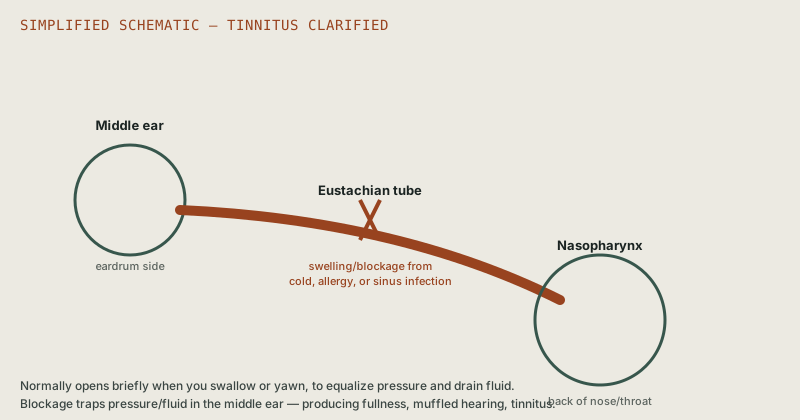
The Eustachian tube connects the middle ear to the back of the nose and throat, and normally stays closed, briefly opening when you swallow, yawn, or chew to equalize pressure and drain fluid. When it doesn't work properly — staying too closed (the more common pattern) or, less often, staying abnormally open — the result is Eustachian tube dysfunction (ETD), and it's genuinely common: research places adult ETD prevalence in the US at around 4.6% at any given time, a large enough share of the population that it's a reasonable thing to consider rather than an obscure diagnosis.
The symptom pattern
ETD produces a recognizable cluster: aural fullness or pressure, muffled hearing, popping or crackling sounds, sometimes mild ear pain, and — relevant here — tinnitus. Symptoms commonly follow a cold, sinus infection, or allergic flare-up, since nasal and throat inflammation from any of these can directly affect how well the Eustachian tube opens and closes. For most people, ETD following a cold resolves within a few weeks as the underlying congestion clears; the pattern becomes chronic ETD when it persists well beyond that or keeps recurring.
How it connects to actual ear infections
When the Eustachian tube can't drain properly, fluid can build up behind the eardrum — a condition called otitis media with effusion (sometimes informally "glue ear," though that term is used more for the pediatric version). That fluid buildup on its own can cause muffled hearing and tinnitus even without infection; if the fluid becomes infected, it progresses to true otitis media (an ear infection), which adds pain and sometimes fever to the picture. Long-standing ETD is associated with a range of downstream middle ear complications beyond infection, including eardrum retraction, which is part of why chronic or recurring symptoms are worth a proper evaluation rather than repeatedly self-treating each episode.
A less common but distinct variant
Most ETD involves a tube that doesn't open enough. A less common form, called patulous Eustachian tube dysfunction, is the opposite: the tube stays abnormally open, which can let sound travel directly from your nasal and throat cavity into your ear — some people with this variant describe hearing their own voice or breathing unusually loudly, or even hearing the sound of their own pulse. If your symptoms include this specific pattern rather than fullness and muffled hearing, mentioning it precisely helps a clinician distinguish patulous ETD from the more common obstructive form, since the underlying mechanism — and sometimes the management — differs.
What increases the risk
Upper respiratory infections and allergic rhinitis are the two most consistently cited triggers, since both cause the kind of nasal and throat inflammation that affects Eustachian tube function directly. Sinus infections and, less directly, structural issues in the nose or throat (like a deviated septum) can also contribute. Rapid pressure changes are a separate trigger worth knowing about specifically — see diving, flying, and ear barotrauma for how altitude and depth changes can strain the same Eustachian tube mechanism, even in people who otherwise have no chronic ETD symptoms. This overlap with allergies is worth knowing about specifically: if your tinnitus and ear fullness seem to track with allergy season or a chronic postnasal drip, ETD driven by ongoing nasal inflammation is a reasonable explanation to raise with a doctor, alongside standard allergy treatment.
What to actually do about it
- Short-term, cold- or allergy-related ETD often resolves on its own alongside the underlying congestion; standard self-care (decongestants, nasal saline, treating allergies) is a reasonable first step, and swallowing/yawning/chewing gum can help the tube open more actively.
- Persistent or recurring ETD — lasting more than a few weeks, or coming back repeatedly — is worth a proper ENT evaluation, which typically includes an ear exam and sometimes a tympanometry test (measuring how well your eardrum and middle ear respond to pressure changes) to confirm the diagnosis.
- An ear that keeps discharging despite drops is a different problem and needs to be seen rather than re-treated. The sustained negative pressure ETD creates can draw part of the eardrum inward into a pocket, and a pocket is where a cholesteatoma starts — a skin growth that erodes what it presses against, and the one thing in this territory that needs surgery rather than time.
- Confirmed fluid buildup or infection may need more direct treatment, ranging from antibiotics for true infection to, for select chronic and treatment-resistant cases, procedures like balloon dilation of the Eustachian tube — a decision for an ENT to make based on your specific findings, not something to self-diagnose toward.
The practical takeaway
If tinnitus shows up alongside ear fullness, muffled hearing, or popping/crackling sounds — especially following a cold, sinus infection, or allergy flare — Eustachian tube dysfunction is a common, genuinely worth-checking explanation that's easy to overlook in favor of assuming the tinnitus is unrelated to what feels like an ordinary head cold.
Sources
Frequently asked questions
How common is Eustachian tube dysfunction?+
More common than most people expect — research places adult prevalence in the US at around 4.6% at any given time. That is a large enough share of the population to be worth considering rather than treating as an obscure diagnosis.
How do I know if my tinnitus is from my Eustachian tube?+
The cluster is recognisable: aural fullness or pressure, muffled hearing, popping or crackling, sometimes mild ear pain, with tinnitus alongside. It typically follows a cold, sinus infection or allergy flare, since inflammation in the nose and throat directly affects how well the tube opens.
When should I stop waiting for Eustachian tube dysfunction to clear on its own?+
Most cold-related cases resolve within a few weeks as the congestion clears. If it lasts beyond that or keeps recurring, get an ENT evaluation rather than self-treating each episode — long-standing dysfunction is associated with downstream middle ear problems including eardrum retraction.
Related reading
causes
Vestibular Migraine: Tinnitus, Vertigo and Ear Fullness Without Ménière's
Vestibular migraine produces the same ear triad as Ménière's — tinnitus, fluctuating hearing loss, aural pressure — and the features that separate them are specific and checkable.
4 min read
causes
Superior Canal Dehiscence Syndrome and Tinnitus
A rare gap in the inner ear bone can cause strange symptoms — including hearing your own heartbeat, footsteps, and eye movements.
4 min read
causes
Tinnitus and Earwax Buildup: A Fixable Cause
One of the simplest, most overlooked causes of tinnitus is also one of the easiest to fix — impacted earwax.
4 min read
causes
Tinnitus and Hearing Loss: The Connection Explained
Most tinnitus shows up alongside some degree of hearing loss — here's the mechanism researchers think links the two, and what it means for treatment.
4 min read
Eustachian Tube Dysfunction: An Overlooked Tinnitus Cause — https://www.tinnitusclarified.com/articles/eustachian-tube-dysfunction
Published 2026-07-22, updated 2026-09-03. Every claim on this page cites a named source; the full list is above.
How this page is maintained
Every factual claim above is tied to one of the 3 named sources listed on this page, last checked . How we decide what to publish explains what counts as a source here and what does not.
When we get something wrong we say so on the corrections page rather than editing it away quietly. If something on this page looks wrong to you — a number, a citation, a claim that has been superseded — tell us, and say which sentence.
Tools & resources
Free tool
Medications linked to tinnitus
10 drug classes with the actual figures, and which drugs within each class the signal really sits on.
Free tool
Tinnitus impact self-check
See how much tinnitus is actually affecting daily life, mood, and coping — 2 minutes, free.
Research library
Every source cited on this site
The primary studies behind this article and every other, aggregated in one place.