Tinnitus and Hearing Loss: The Connection Explained
Ask someone with tinnitus whether they also have hearing loss, and a large share will say yes — often loss they hadn't fully registered until it was measured. The overlap between the two isn't a coincidence; it's central to the leading explanation for why tinnitus happens at all.
The "turn up the volume" theory
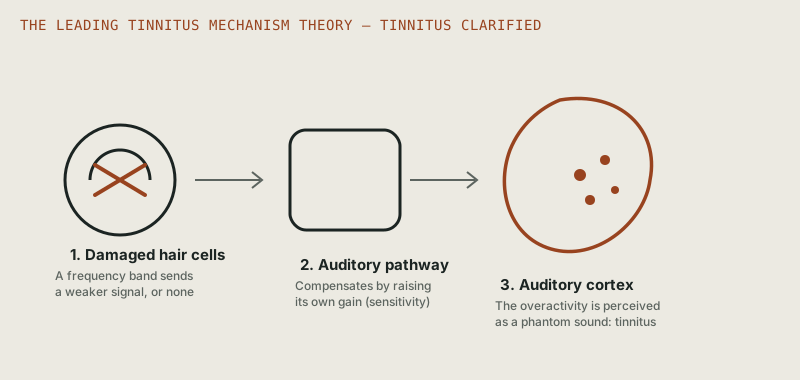
The cochlea, the spiral structure in the inner ear, is lined with tiny hair cells that convert sound vibrations into the electrical signals your brain interprets as hearing. Different hair cells respond to different frequencies. When hair cells in a particular frequency range are damaged — by noise, aging, or another cause — they send a weaker signal, or none at all, for that frequency band.
The auditory pathways in the brainstem and auditory cortex appear to respond to that reduced input by increasing their own gain, essentially turning up the sensitivity for the affected frequency range to compensate for the weaker signal coming in. Many researchers believe this compensatory overactivity is what gets perceived as tinnitus — the brain "filling in" a frequency band it's no longer reliably receiving. It's a theory supported by a consistent pattern: tinnitus pitch very often matches the frequency range where a person's hearing loss is greatest.
Why this matters for treatment
This mechanism is a big part of why hearing aids are frequently effective for tinnitus, even though they're not marketed as a tinnitus treatment. By restoring audible input across the damaged frequency range, they reduce the gap the auditory system was compensating for — and for many patients, tinnitus becomes noticeably less prominent once amplification is in place. It's also why an audiologist's first steps for new tinnitus almost always include a full hearing test, even if you don't feel like your hearing has changed: measurable loss is common even when it hasn't been noticeable day to day, since it tends to develop gradually and the brain adapts to slowly.
Hearing loss you might not have noticed
High-frequency hearing loss — the kind most associated with noise exposure and aging — often affects sounds like consonants (s, f, th) before it affects lower-pitched sounds, so speech can still seem "audible" while actually becoming harder to follow, especially in noisy rooms. That's a common pattern in people who are surprised to learn they have measurable loss at their first audiology appointment for tinnitus.
What an audiogram actually measures
An audiogram is a graph of the quietest sound you can hear at each of several standard frequencies, tested one ear at a time in a sound booth. The result maps your hearing across the pitch range relevant to speech and everyday sound, and it's what lets an audiologist see precisely which frequencies — if any — show reduced sensitivity, rather than relying on a general sense of "can you hear okay." For tinnitus specifically, this matters because the audiogram often reveals a dip at or near the same frequency as the tinnitus pitch, which is the clearest available evidence for the "turn up the volume" mechanism described above, and it's genuinely common for someone to have a measurable dip they hadn't noticed subjectively at all, since gradual loss is often masked by the brain's own adaptation to it.
The test itself is quick, painless, and typically takes 20–30 minutes, usually followed by a speech-in-noise test that more directly reflects the everyday difficulty many people actually notice (following conversation in a restaurant, for instance) even when pure-tone results look only mildly affected.
If you want a rough first signal before booking an appointment, this site's free online hearing test checks tone audibility ear by ear, and the digits-in-noise test checks the speech-in-noise skill described above — neither replaces a real audiogram, but either can be a reason to move a "maybe I should get this checked" up the priority list.
Not every case fits this pattern
Hearing loss is the most common contributor, not the only one. Tinnitus can occur with normal hearing test results, particularly when it's linked to causes like TMJ dysfunction, certain medications, or vascular issues (see the article on pulsatile tinnitus). That's part of why a proper evaluation — not just an assumption about noise damage — is worth getting if tinnitus is new or changing.
Sources
Frequently asked questions
Can I have tinnitus with a normal hearing test?+
Yes. Hearing loss is the most common contributor to tinnitus, not the only one — it can occur alongside normal audiogram results, particularly when linked to causes like TMJ dysfunction, certain medications, or vascular issues. That is part of why a proper evaluation is worth getting rather than assuming noise damage.
Why does my tinnitus pitch match the frequency where my hearing is worst?+
That pattern is the main evidence for the leading explanation. When hair cells in a particular frequency range are damaged, they send a weaker signal, and the auditory pathways appear to compensate by increasing their own gain for that range. Many researchers believe this compensatory overactivity is what gets perceived as tinnitus — the brain filling in a band it is no longer reliably receiving.
Can hearing aids help with tinnitus?+
Frequently, even though they are not marketed as a tinnitus treatment. By restoring audible input across the damaged frequency range, they reduce the gap the auditory system was compensating for, and for many people tinnitus becomes noticeably less prominent once amplification is in place.
Related reading
causes
Musical Ear Syndrome: Hearing Music That Isn't There
Hearing songs, choirs or an orchestra with nothing playing is usually a hearing phenomenon, not a psychiatric one — here is what is actually known about it.
7 min read
causes
Vestibular Migraine: Tinnitus, Vertigo and Ear Fullness Without Ménière's
Vestibular migraine produces the same ear triad as Ménière's — tinnitus, fluctuating hearing loss, aural pressure — and the features that separate them are specific and checkable.
4 min read
causes
Ménière's Disease vs. Tinnitus: How to Tell Them Apart
Tinnitus is one symptom of Ménière's disease, not a separate condition — here's how to recognize the difference and why it changes the treatment path.
3 min read
causes
Swimmer's Ear (Otitis Externa) and Tinnitus
An outer ear canal infection is common and usually minor, and can produce temporary tinnitus alongside its more familiar symptoms.
4 min read
Tinnitus and Hearing Loss: The Connection Explained — https://www.tinnitusclarified.com/articles/tinnitus-and-hearing-loss
Published 2026-07-26, updated 2026-09-03. Every claim on this page cites a named source; the full list is above.
How this page is maintained
Every factual claim above is tied to one of the 2 named sources listed on this page, last checked . How we decide what to publish explains what counts as a source here and what does not.
When we get something wrong we say so on the corrections page rather than editing it away quietly. If something on this page looks wrong to you — a number, a citation, a claim that has been superseded — tell us, and say which sentence.
Tools & resources
Free tool
Medications linked to tinnitus
10 drug classes with the actual figures, and which drugs within each class the signal really sits on.
Free tool
Tinnitus impact self-check
See how much tinnitus is actually affecting daily life, mood, and coping — 2 minutes, free.
Research library
Every source cited on this site
The primary studies behind this article and every other, aggregated in one place.